
Incoterms · Road freight
Incoterms for Road Freight: Which Rules Apply, and Which Do Not
Incoterms 2020 contains eleven rules, but only seven of them apply to road freight: EXW, FCA, CPT, CIP, DAP, DPU and DDP. The remaining four — FAS, FOB, CFR and CIF — are written for sea and inland waterway transport, where risk passes at the ship. Agreeing one of those on a road consignment leaves the most important question in the contract undefined.
Eleven rules, seven of which concern you
The Incoterms rules published by the International Chamber of Commerce define who arranges what, who pays for what, and — separately — who carries the risk at each stage of an international sale. The 2020 edition contains eleven of them, and they fall into two groups that most glossaries list side by side without comment.
Seven rules apply to any mode of transport: EXW, FCA, CPT, CIP, DAP, DPU and DDP.
Four apply only to sea and inland waterway transport: FAS, FOB, CFR and CIF.
If your goods travel by road, only the first group is available to you. That is not a stylistic preference — it follows from how the second group is written.
Why the sea rules break on a trailer
FOB defines delivery as the moment the goods are placed on board the vessel. CFR and CIF build on the same moment and add freight, and freight plus insurance, to the seller’s account. FAS puts delivery alongside the ship.
Every one of those definitions points at a vessel. A curtain-side trailer leaving Milano for Istanbul never touches one, so the clause has no moment of transfer to attach to. The contract then contains a term that cannot be applied — which only becomes visible when something has gone wrong and both parties need to know who was carrying the risk.
FOB is the most frequent offender, because it is the abbreviation everyone in trade knows. It gets typed into contracts out of habit, on shipments that will never see a port.
The distinction that actually costs money
Whatever rule you choose, keep two questions apart:
- Who pays for carriage to a given point
- Who carries the risk if the goods are damaged or lost
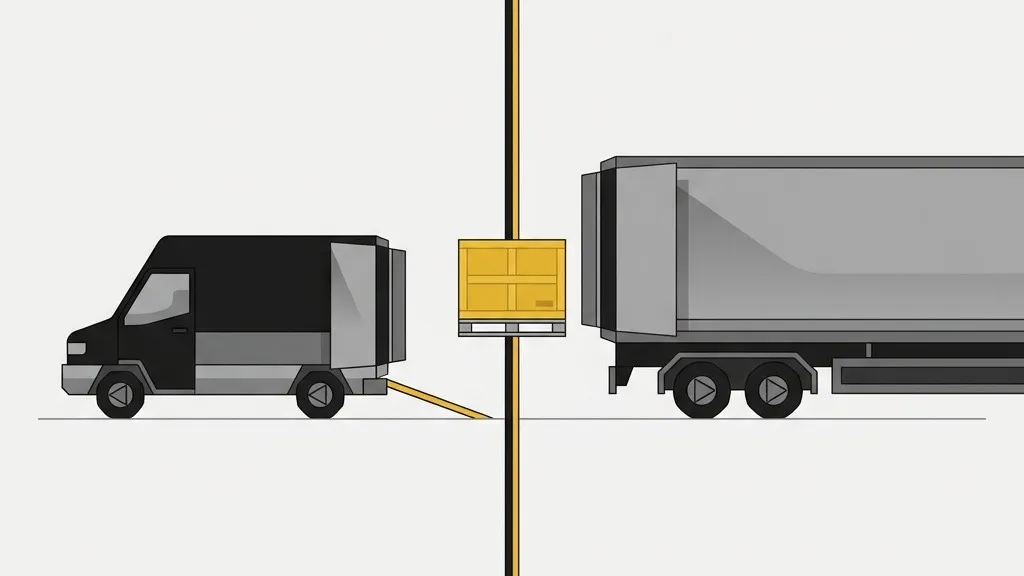
For most rules the two move together. For CPT and CIP they deliberately do not. Under both, the seller pays the carriage to the named destination — but risk passes to the buyer the moment the goods are handed to the first carrier.
On a groupage consignment from Italy to Türkiye, where our records show an average transit of 6.3 days, that means the buyer bears the risk for the entire journey while the seller pays for it. Both parties usually assume the opposite.
The seven rules, briefly
| Rule | Where the seller’s obligation ends |
|---|---|
| EXW | At his own premises, goods not loaded |
| FCA | On handing over to the named carrier |
| CPT | Carriage paid to destination, risk passes earlier |
| CIP | As CPT, plus insurance cover |
| DAP | At the named place, ready for unloading |
| DPU | At the named place, unloaded |
| DDP | At the named place, duties paid |
Each has its own page with the risk transfer set out in full, and with what the rule means when the consignment shares a trailer with other shippers’ goods. Who pays for which stage — and where the risk actually moves — is set out below.
What changes when the load is shared
Most explanations of Incoterms assume your goods travel alone. In groupage they do not, and three things follow.
The named place matters more. Under FCA the handover point defines the risk transfer, and in consolidated traffic that point is usually a terminal rather than a factory gate. We operate five of them in Italy — Milano, Vicenza, Torino, Bologna and Firenze — and naming one of them in the contract removes an ambiguity that otherwise surfaces at the worst moment.
Unloading is not a detail. DPU is the only rule that obliges the seller to unload. On a consolidated trailer, unloading happens at a terminal alongside other consignments, so who bears that step needs to be settled rather than assumed.
Customs delay is collective. Whoever the Incoterm makes responsible for clearance, the consequence of getting it wrong is not confined to one consignment. An incomplete file holds the vehicle, and every shipment on it waits. That is the practical reason we check documents before loading — and why customs sits inside our own group rather than being bought in.
Insurance is a separate question
Only CIP and CIF require the seller to insure the goods, and since the 2020 edition CIP demands cover at Institute Cargo Clauses (A) level while CIF remained at the minimum.
Under every other rule, nobody is obliged to insure anything. It is worth knowing that a carrier’s liability is not a substitute: under the CMR convention it is capped at 8.33 special drawing rights per kilogram of gross weight — calculated from what the goods weigh, not what they are worth. The arithmetic is here.
Choosing, in practice
There is no generally correct rule. The useful question is which party is better placed to handle each step — and on the Europe–Türkiye corridor the answer usually turns on customs rather than on transport.
EXW looks simplest for the seller and often is not: export clearance falls to a buyer who may have no standing to file a declaration in the country of departure. DDP looks simplest for the buyer and shifts Turkish import duties onto a seller who has to be registered there to pay them.
Most of what we carry sits between those two, on DAP or FCA. Which one fits your transaction depends on where your goods are, who your customs representative is at each end, and what you want to be responsible for.
This page is general information about the rules and does not replace advice on a specific contract. Tell us what you are shipping and where it has to go, and we will tell you what the route looks like — including the measured transit times on it.
Who carries what, rule by rule
Gold marks what the seller carries. The marker shows where risk passes to the buyer — under CPT and CIP that is far earlier than the cost obligation ends.
| Rule | Loading at seller | Export clearance | Main carriage | Import clearance | Unloading at destination |
|---|---|---|---|---|---|
| EXW | Loading at seller: Buyer | Export clearance: Buyer | Main carriage: Buyer | Import clearance: Buyer | Unloading at destination: Buyer |
| FCA | Loading at seller: Seller | Export clearance: Seller | Main carriage: Buyer | Import clearance: Buyer | Unloading at destination: Buyer |
| CPT | Loading at seller: Seller | Export clearance: Seller | Main carriage: Seller | Import clearance: Buyer | Unloading at destination: Buyer |
| CIP | Loading at seller: Seller | Export clearance: Seller | Main carriage: Seller | Import clearance: Buyer | Unloading at destination: Buyer |
| DAP | Loading at seller: Seller | Export clearance: Seller | Main carriage: Seller | Import clearance: Buyer | Unloading at destination: Buyer |
| DPU | Loading at seller: Seller | Export clearance: Seller | Main carriage: Seller | Import clearance: Buyer | Unloading at destination: Seller |
| DDP | Loading at seller: Seller | Export clearance: Seller | Main carriage: Seller | Import clearance: Seller | Unloading at destination: Buyer |
FCA: the seller loads only when the named place is his own premises. Elsewhere he presents the goods ready for unloading.
Sources
External figures on this page come from the publicly available sources below. They are not our own measurements.
- 01International Chamber of Commerce — Incoterms 2020 rules2026
- 02European Commission — Türkiye: Customs Unions and preferential arrangements2026
Updated: 27 July 2026
Frequently asked questions
Which Incoterms rules can I use for road freight?
The seven rules the ICC designates for any mode of transport: EXW, FCA, CPT, CIP, DAP, DPU and DDP. These are the only ones that make sense when the goods travel on a trailer, because they define delivery in terms of places and carriers rather than a ship.
Why can I not use FOB or CIF for a truck shipment?
Because both define the moment risk passes in relation to a vessel — FOB when the goods are on board, CIF likewise with insurance and freight added. A trailer never crosses a ship's rail, so the clause has no defined moment of transfer. In a dispute you would be arguing about a point in the contract that does not exist. FAS and CFR have the same problem.
Is FOB really that common a mistake?
It is one of the most common in international trade. FOB is the best-known abbreviation in the field, so it gets written into contracts by habit, including on shipments that never see a port. The ICC has flagged the practice repeatedly across editions of the rules.
What is the difference between the cost transfer and the risk transfer?
They are separate questions, and in two rules they deliberately fall apart. Under CPT and CIP the seller pays the carriage all the way to the named destination, but risk passes as soon as the goods are handed to the first carrier. So the buyer carries the risk for a journey he is not paying for. Confusing the two is the single most expensive misunderstanding in this area.
Which rule is most common for groupage between Europe and Türkiye?
In practice DAP and FCA cover most of what we see. DAP puts everything up to the named place on the seller, which suits a buyer who wants a single delivered figure. FCA fits when the seller wants his obligation to end at a collection point or terminal. Which is right for you depends on who is better placed to handle customs at each end.
Does the Incoterm decide who does the customs clearance?
Yes, and this is where the choice bites hardest on this route. EXW leaves export clearance to the buyer, which is often impractical because a foreign buyer cannot easily file an export declaration in the country of departure. DDP puts import duties in Türkiye on the seller, which requires him to be registered there. Everything between those two extremes splits the work differently.
Let's talk about your Europe–Türkiye shipment
Send us the shipment details and we will confirm the collection terminal and the expected departure.