
Pricing · Part loads
What Determines the Cost of Groupage Freight to Türkiye
Part-load freight is not priced by weight alone. What you occupy on the trailer — the loading metres — usually decides the figure, because a light pallet blocks the same floor space as a heavy one. On top of that sit the collection and delivery points, the customs effort your goods require, and their value. We do not publish rates: with those variables, any headline figure would carry conditions you would only discover later.
Why nobody credible publishes a rate card for this
Search for the cost of road freight to Türkiye and you will find price ranges quoted per kilogram, unsourced, presented as though they settled the question. They do not, and the reason is structural rather than evasive.
Part-load freight is sold on space, and space is only loosely related to weight. Two pallets side by side on the same trailer can differ by a factor of twenty in weight and cost nearly the same to move, because what they consume — floor area on a vehicle with a fixed floor — is identical.
Any figure quoted per kilogram without knowing the dimensions is either a guess or has conditions attached that surface later.
The unit that actually governs the price
The working unit in European road groupage is the loading metre: one metre of trailer floor across its full width.
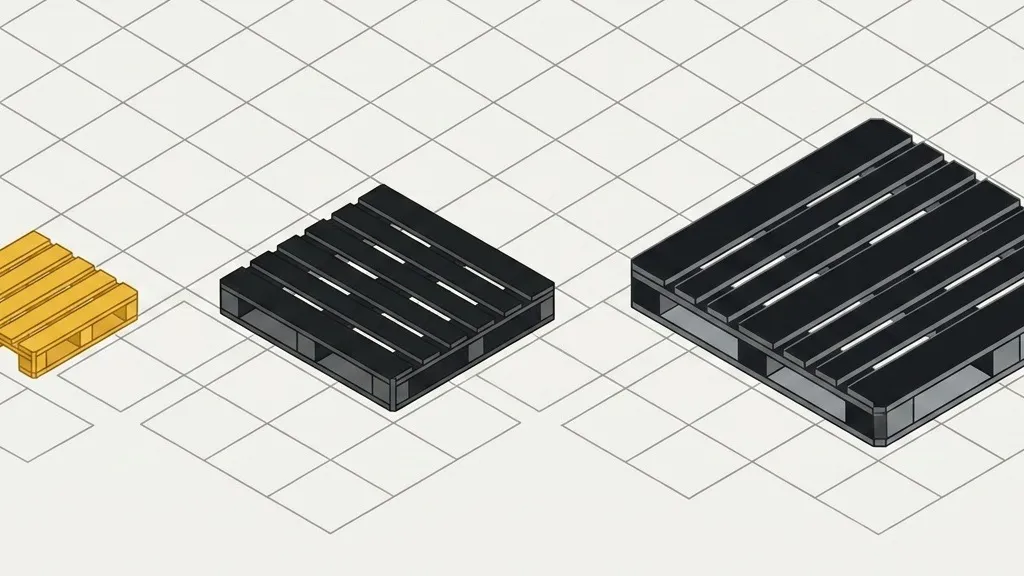
A standard curtain-side semi-trailer offers roughly 13.6 loading metres. A Euro pallet measures 1.2 by 0.8 metres, and whichever way you turn it, it occupies about 0.4 of a loading metre — which is why a full trailer takes somewhere around 33 to 34 of them.
The arithmetic that follows is straightforward. Two loading metres is about 15 % of the vehicle, and that share is what you are buying. Weight enters as a second constraint: a trailer reaches its payload limit before it runs out of floor if the cargo is dense enough.
Because both constraints exist, forwarders convert volume into a notional weight and charge whichever is higher — actual or volumetric. The conversion factor is not standardised. It is set in the quotation and differs between providers, which means two quotations using different factors cannot be compared by looking at the headline number. Ask what factor applies.
What moves the figure, in order
1. The space you occupy. Loading metres first, weight as the second constraint. This sets the base and everything else adjusts it.
2. Where the goods are collected and delivered. The international leg is often the predictable part; the domestic legs at each end are where cost varies. A consignment within a terminal’s catchment is collected on a routine run. One several hours away needs a dedicated movement. Our five terminals in Italy exist for precisely this reason, and it is visible in the transit data as well as the cost.
3. Customs effort. Not every consignment is equally expensive to clear. The commodity code determines which documents and permits apply, and goods that need product-specific permits carry more work than goods that do not. Where the departure country sits outside the customs union — the UK and Switzerland among our lanes — the origin question adds a further step. The A.TR guide sets out which regime applies where.
4. The value of the goods. Relevant for customs, and relevant for cover. It is worth knowing that the carrier’s liability under the CMR convention is capped at 8.33 special drawing rights per kilogram of gross weight — calculated from weight, not from value. For light, high-value consignments that limit can fall well short of the invoice. We explain the arithmetic here.
5. Timing and capacity. Groupage depends on vehicles filling. On a lane with steady volume a consignment waits less; on a thin lane it waits longer. That is why Poland runs faster than Germany despite lying further east — and it is the same mechanism that makes capacity tighter at some points in the year than others.
What we will not do
We do not publish rates on this site. Given the variables above, a headline figure would be useful only if it came with the conditions that make it true — and a price with a page of conditions is not a price.
What we will do is answer quickly. Send the details below and you get a real number for your actual consignment rather than a range you then have to negotiate against.
The six things a quotation needs
- Collection address — determines the terminal and the domestic leg
- Delivery address — determines the corridor and the final leg
- What the goods are — drives the commodity code, and with it the document set
- Weight — the second constraint after space
- Dimensions per handling unit — without these, no honest part-load quote is possible
- Value — needed for customs, and to judge whether cover makes sense
If your goods carry any special requirement — temperature, permits, restrictions — say so at the start. Those requirements bring documents with them, and documents are what stretch a transit.
One thing worth checking before you compare quotes
Ask each provider two questions: what conversion factor they apply between volume and weight, and what transit time they are quoting for that lane.
On the second, you can already check ours. Every corridor we run has its measured average published, together with the fastest and slowest case we recorded. A quotation that promises three days on a lane where the measured mean is over six is not a better price. It is a different promise.
Frequently asked questions
Why can you not just publish a price per kilogram?
Because weight is often not what you are paying for. A pallet of cushions and a pallet of machine parts occupy the same floor space on the trailer, and floor space is the scarce resource. Pricing by weight alone would overcharge the heavy consignment or undercharge the light one — which is why part-load pricing works from loading metres, with weight as a second constraint.
What is a loading metre?
One metre of trailer floor across its full width. A standard curtain-side semi-trailer offers about 13.6 loading metres. A Euro pallet at 1.2 by 0.8 metres takes roughly 0.4 of one, however it is turned — which is why a full trailer holds around 33 to 34 of them. If your consignment occupies two loading metres, you are paying for about 15 % of the vehicle.
How does volume turn into a chargeable weight?
Forwarders convert cubic metres into a notional weight and charge whichever is higher — the actual weight or the volumetric one. The conversion factor is not universal; it is set in the quotation and differs between providers. Ask for it explicitly, because two quotations using different factors are not comparable.
Which factors move the price most?
Space occupied, then the collection and delivery points, then customs effort. A collection inside a terminal catchment behaves differently from one three hours away. Goods whose commodity code brings permits with it cost more to clear. Everything else — value, service level, seasonality — adjusts the figure rather than setting it.
Why does the destination matter as much as the distance?
Because the domestic legs at each end are often the expensive part. Our five Italian terminals exist for exactly this reason: collection happens locally and consolidation finishes before departure. A consignment far from any terminal carries a longer first leg, and that shows up in the price even though the international distance is unchanged.
What do you need from me to quote?
Collection and delivery addresses, what the goods are, weight, dimensions per handling unit, and the value. Without dimensions no honest part-load quotation is possible — only weight is not enough to establish what you occupy.
Let's talk about your Europe–Türkiye shipment
Send us the shipment details and we will confirm the collection terminal and the expected departure.